







Picture this: In today’s fast-paced economy, being able to change your finances is very important and with short term investments it can result to have a best bet for balancing growth, safety, and easy access, whether you’re a business protecting extra cash or an individual saving for a goal in the near future.

The problem is that there are so many choices that it can be hard to pick the right one. How do you deal with the trade-offs between safety and yield? And if you own a business, how do you keep track of these assets?
This ultimate guide gets to the point. You’ll get a clear, data-driven breakdown of the best short-term investments in 2025, along with real-world examples and a clear explanation of the accounting rules. You’ll know exactly how to use your money for short-term gains without taking on too much risk by the end.
What Do Short Term Investments Mean?
A company or person plans to sell or turn short-term investments into cash within a short period of time, usually 12 months or less.
They aren’t meant to be kept for a long time to grow. Instead, their main goal is to keep capital safe and make a small amount of money on cash that isn’t being used right away.
You can think of them as a fancy parking spot for your money. They let you earn more than a regular savings account while still being easy to get to in case of an emergency or opportunity.
Important Features of Short-Term Investments:
- High Liquidity: You can sell them on a public market quickly and easily without affecting the price too much.
- Short Maturity: They only last for 3, 6, or 12 months.
- Low Risk: The main goal is to keep the capital safe, so they are usually issued by stable organizations like governments or highly rated companies.
The Big Difference Between Short-Term and Long-Term Investments
It’s not just about time that separates short-term and long-term; it’s also about what you want.
| Feature | Short Term Investments | Long Term Investments |
|---|---|---|
| Holding Period | ≤ 12 months | > 12 months |
| Primary Goal | Liquidity & Capital Preservation | Capital Appreciation & Growth |
| Risk Tolerance | Low to Moderate | Moderate to High |
| Examples | Treasury Bills, Money Market Funds | Stocks, Real Estate, Bonds held to maturity |
| Volatility | Low | Can be High |
So, are short-term investments good or bad?For the person who owns them, they are definitely assets. They are things that a business or person owns that are thought to have value now and will have value in the future.
Are Short Term Investments Current Assets?
Yes, for sure.
Current assets on a company’s balance sheet are short-term investments.
All assets that are expected to be turned into cash within one business year or one operating cycle are called current assets. Short-term investments are, by definition, held for less than 12 months, so they fit perfectly into this group.
Where on the balance sheet do short-term investments show up?
They come right after “Cash and Cash Equivalents” in the current assets section. This is how the order usually goes:
- Assets Right Now
- Cash and Things That Are Like Cash
- Investments for a Short Time
- Accounts Receivable
- Stock
A Few Examples of Short Term Investments
It’s time to put what we’ve learned into practice. What do these assets really look like in the real world? These are the most common types of short-term investments, and each has its own level of risk and reward.
1. T-Bills, or Treasury Bills
T-Bills are short-term loans from the U.S. government that have to be paid back in a few days to 52 weeks. Because the U.S. government backs them up, they are thought to be one of the safest short-term investments in the world.
How they work: You buy them for less than their face value and get the full face value when they mature. The difference is the interest you make.
Age: 4, 8, 13, 26, or 52 weeks.
2. CDs, or certificates of deposit
A CD is a type of time deposit that banks offer. It has a set maturity date and interest rate. You agree to leave your money in the bank for a certain amount of time (like 3, 6, or 12 months), and in return, you get a higher interest rate than you would in a savings account.
Safety: Each depositor is insured by the FDIC up to $250,000 per institution.
Disadvantage: Your money is stuck. Usually, there is a fee for withdrawing money early.
3. Funds for the Money Market (MMFs)
These are mutual funds that put money into short-term, high-quality debt like T-Bills and commercial paper. They are a popular best short term cash investment because they try to keep the net asset value (NAV) of each share stable at $1.
Key Benefit: They let you write checks and make electronic transfers, which makes it easy to get to your money.
4. Commercial Paper
This is a type of short-term, unsecured debt that big companies use to pay for their accounts receivable, inventories, and other short-term debts. Because the minimum denominations are so high, it’s usually only available to institutional investors.
Risk: A little higher than T-Bills because it depends on how creditworthy the company that issues them is.
Return: Yields are usually higher than T-Bills because they are riskier.
5. Stocks for Short-Term Investments
Individual stocks are usually thought of as long-term and volatile, but a strategic approach can help you find short-term investments stocks. This means putting money into stable, dividend-paying companies in sectors that don’t change often, like utilities and consumer staples, with the goal of selling within a year.
Warning: This is a lot riskier than the other choices. Stock prices can change a lot, which makes them less good for keeping your money safe.
Comparison Table: Different Kinds of Short-Term Investments
| Investment Type | Risk Level | Potential Return | Liquidity | Best For |
|---|---|---|---|---|
| Treasury Bills | Very Low | Low | Very High | Ultimate safety & liquidity |
| Certificates of Deposit | Very Low | Low to Medium | Low (until maturity) | Guaranteed returns, FDIC insurance |
| Money Market Funds | Very Low | Low | Very High | Easy access, check-writing |
| Commercial Paper | Low to Medium | Medium | High | Institutional investors seeking slightly higher yield |
| Short-Term Corporate Bonds | Low to Medium | Medium | Medium | A step up in yield from government debt |
| Short-Term Stocks | High | High (Potential) | High | Investors comfortable with volatility for higher gains |
The Best Short-Term Investments Right Now 2025
The “best” investment is the one that fits your goals perfectly, whether that’s safety, yield, or a mix of the two. As we move through 2025, the interest rate environment has opened up new chances for short-term investments with high returns. Here is a list of the best options.
Safe Short-Term Investments (Keeping Your Money Safe)
These are the best choices for you if your main goal is not to lose money.
- High-Yield Savings Accounts (HYSAs): Even though they aren’t traditional “investments,” modern HYSAs from online banks are an important part of a cash and short-term investments strategy. They have FDIC insurance and rates that are often better than those of money market funds, and you can get your money right away.
- Treasury Bills: Because the Fed will keep rates higher for a longer time in 2025, T-Bills still offer good, risk-free returns. They are the best short-term safe investments.
- Money Market Funds: The yields on MMFs have gone up a lot. For the safest investments, look for funds that have low expense ratios and mostly invest in government securities.
High Yield Short Term Investments (Looking for Better Returns)
These short-term investments have high returns compared to their risk profiles, so if you’re willing to take on a little more risk for a better return, you might want to look into them.
- Short-Term Corporate Bond ETFs: Exchange-Traded Funds (ETFs) like the Vanguard Short-Term Corporate Bond ETF (VCSH) give you instant access to a wide range of investment-grade corporate bonds that will mature in 1 to 3 years. They have less risk than government bonds and pay more interest.
- Ultra-Short-Term Bond Funds: These mutual funds or ETFs buy bonds that will mature in less than a year. They have a higher yield than MMFs but a lower price stability. However, price changes are usually small.
- Brokered CDs: You can buy these through a brokerage account, which is different from bank CDs.
These high-risk investments for a short period of time are risky and should only make up a small part of a well-diversified portfolio.
- Cryptocurrency Staking and Short-Term Trading: You can make a lot of money in a short amount of time by “staking” certain cryptocurrencies or trading them actively, but the prices are very unstable.
- Using options strategies in stock options trading can lead to big short-term gains, but it’s hard and could mean losing all of your money.
The best short-term investments in the UK are:
For our UK readers, the situation is the same, but with different tools:
- Sterling Money Market Funds: The UK version, which puts money into short-term UK government and corporate debt.
- Short-Term Gilts are UK government bonds that will mature in less than five years, with the shortest terms being the most important here.
Investments For a Short Time in Accounting and the Balance Sheet
Understanding how these investments are treated in accounting is crucial for business owners, investors, and analysts. Let’s demystify short term investments accounting.
How are short term investments recorded?
Under U.S. GAAP, short term investments are recorded on the balance sheet at their fair value—that is, their current market price.
The process works like this:
-
Initial Recognition: When purchased, the investment is recorded on the balance sheet at its cost (including brokerage fees).
-
Subsequent Measurement: At the end of each reporting period (e.g., quarterly or annually), the value of the investment is adjusted to its current fair market value.
-
Unrealized Gains/Losses: The difference between the cost and the fair value is recorded as an “unrealized gain or loss” in the income statement. This directly impacts net income.
Where to find short term investments on financial statements?
As discussed, you’ll find the total value listed as a line item under “Current Assets” on the Balance Sheet. More detailed disclosures are always provided in the notes to the financial statements, which break down the types of investments held and their individual fair values.
How to Calculate Short Term Investments
The calculation on the balance sheet is straightforward: it’s the sum of the fair value of all holdings intended to be sold within one year.
Example: Short Term Investments Accounting Entry
Let’s say ABC Company buys $100,000 in Treasury Bills on December 1, 2024.
-
Initial Purchase (Dec 1, 2024):
-
Debit: Short Term Investments – $100,000
-
Credit: Cash – $100,000
-
On December 31, 2024 (year-end), the fair value of those T-Bills has increased to $101,000 due to market interest rate movements.
-
Year-End Adjustment (Dec 31, 2024):
-
Debit: Short Term Investments – $1,000
-
Credit: Unrealized Gain on Investments (Income Statement) – $1,000
-
The balance sheet now shows Short Term Investments at $101,000.
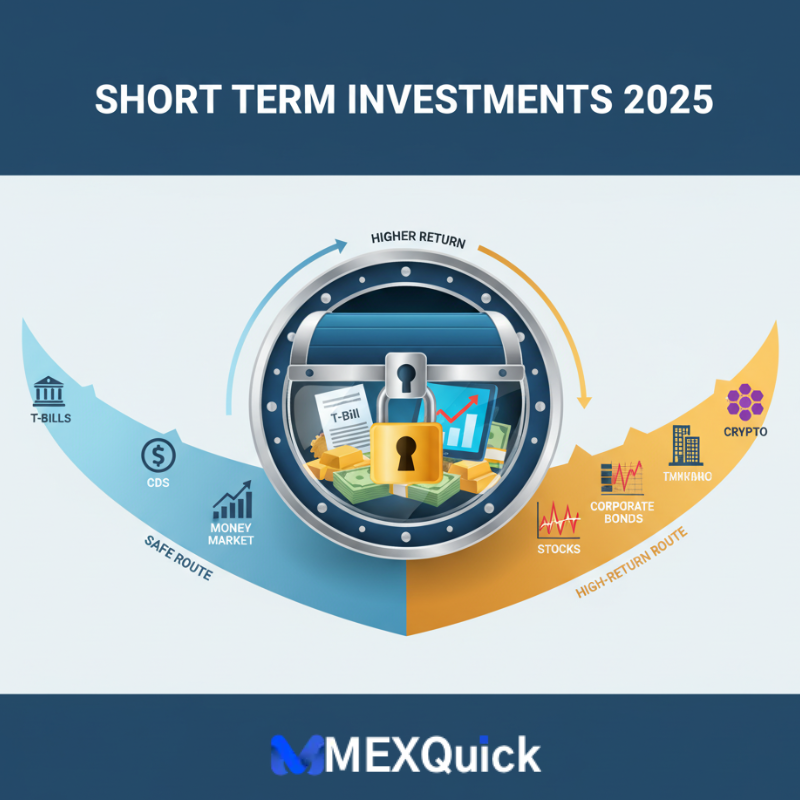
Short Term Investments: Safe vs High Risk
Choosing the right path depends entirely on your risk tolerance. Let’s map it out.
The Safety-First Approach: Short Term Safe Investments
This strategy is for the capital preserver. Your portfolio would be heavily weighted in:
-
FDIC/NCIA-Insured Accounts (Savings, CDs)
-
U.S. Government Securities (T-Bills, I-Bonds)
-
High-Quality Money Market Funds
The trade-off? Lower potential returns. In exchange for near-zero risk, you accept yields that may just outpace inflation.
The Yield-Chaser’s Path: High Return Short Term Investments
This path accepts higher volatility for the chance of greater rewards. This portfolio might include:
-
Short-Term Corporate Bond Funds
-
High-Yield (“Junk”) Bond ETFs (with very short durations)
-
Dividend Stocks for short-term trading
-
Cryptocurrencies or other speculative assets
The risk here is significant. A market downturn could see the value of your portfolio drop right when you need the cash.
The Risk vs. Return Map for Short Term Investments
(Imagine a simple chart here)
Y-Axis (Return): Low ——————————–> High
X-Axis (Risk): Low ——————————–> High
-
Bottom-Left Corner: Cash, Savings Accounts, T-Bills (Low Risk, Low Return)
-
Middle: Money Market Funds, CDs, Short-Term Corporate Bonds (Low-Medium Risk, Medium Return)
-
Top-Right Corner: Stocks, Crypto, Options (High Risk, Potential High Return)
Your ideal short term investments options lie along this spectrum. A balanced approach might place the core of your portfolio in the middle, with small, calculated allocations to the higher-risk end.
Choosing the Best Short Term Investment Strategy
You have the pieces. Now, let’s build a strategy. Follow this numbered list to choose your best short term investments.
-
Define Your “Why” and Timeline.
-
Are you saving for a down payment in 9 months? (Ultra-Safe)
-
Building an emergency fund? (Safe & Liquid)
-
Parking business cash for a quarterly tax payment? (Safe & Liquid)
-
Speculating with “fun money”? (Higher Risk)
-
-
Assess Your Risk Tolerance Honestly.
-
Will a 5% drop in your principal keep you up at night? If yes, stick to government-backed securities and insured accounts.
-
-
Ladder Your Investments for Flexibility.
-
A “CD Ladder” is a classic strategy. Instead of investing $12,000 in one 12-month CD, you invest $1,000 in a 3-month CD, $1,000 in a 6-month CD, $1,000 in a 9-month CD, and so on. As each CD matures, you have access to a portion of your cash, which you can then reinvest at potentially higher rates.
-
-
Diversify Your Short-Term Holdings.
-
Don’t put all your eggs in one basket. Allocate your cash across different types. For example:
-
40% in a High-Yield Savings Account for instant access.
-
30% in a Treasury Bill ETF for safety and yield.
-
20% in a Short-Term Corporate Bond ETF for a yield boost.
-
10% in a higher-risk asset (if your tolerance allows).
-
-
-
Understand the Tax Implications.
-
Interest from Treasuries is exempt from state and local income tax, which can be a significant advantage for investors in high-tax states.
-
Returns from other investments are typically taxed as ordinary income.
-
For 2025, a smart strategy is to take advantage of the higher interest rate environment by locking in yields with T-Bills and CDs while maintaining a core emergency fund in a high-yield savings account.
Conclusion: Secure Your Financial Flexibility in 2025
Short term investments are the unsung heroes of a smart financial plan. They provide a critical bridge between the cash in your wallet and your long-term growth portfolio. You now know that they are key current assets on a balance sheet, ranging from the ultra-safe haven of Treasury Bills to the higher-yield potential of short-term corporate bonds.
The landscape in 2025 is ripe with opportunity. The key is to align your choices with your personal risk tolerance and liquidity needs. Don’t fall into the trap of chasing the highest yield at the expense of safety, or clinging to excessive safety and losing ground to inflation.
Ready to put your cash to work?
The first step is the most important. Review your financial goals for the next 6-12 months. Then, explore the best short term investments available today—starting with a high-yield savings account or a Treasury Bill—to secure your financial flexibility and make your money work smarter for you.
Frequently Asked Questions (FAQ)
Q1: What are good short term investments for a beginner?
Good short term investments for beginners are simple, safe, and liquid. Start with a high-yield savings account and money market funds. As you become more comfortable, you can explore Treasury Bills purchased directly from TreasuryDirect.gov.
Q2: Are short term investments always considered assets?
Yes, for the entity that holds them, short term investments are assets. They represent owned economic value. For the issuer (e.g., a company selling commercial paper), it is a liability.
Q3: What is considered a short term investment?
Any highly liquid security that a company or individual plans to hold for one year or less is considered a short term investment. This includes T-Bills, CDs, Money Market Funds, and commercial paper.
Q4: Where can I find short term investments on financial statements?
Look in the “Current Assets” section of the Balance Sheet. The line item is typically labeled “Short Term Investments” or “Marketable Securities.” Detailed information is always in the notes to the financial statements.
Q5: What are the best short term investments in the UK?
The best short term investments in the UK include Sterling Money Market Funds, short-term Gilts (UK government bonds), and fixed-term savings accounts from reputable UK banks.
Q6: Are short term investments current assets or liabilities?
They are current assets. Their placement on the balance sheet and their definition (convertible to cash within one year) confirm this classification.
Q7: How do you calculate the return on short term investments?
The return is typically calculated as a percentage yield. For example, if you buy a 6-month CD for $1,000 and receive $1,020 at maturity, your return is $20. The annualized yield would be ($20/$1,000) * (12/6) = 4%.
Disclaimer: This article is for informational purposes only and not financial advice. Please consult with a licensed financial advisor before making investment decisions.