



The Black Friday history is a narrative far richer and more complex than the modern imagery of doorbuster deals and online shopping carts. Its journey begins not in a store, but with a financial panic: the “Black Friday” of 1869, when a gold market crash plunged the United States into economic turmoil. The term was later adopted, not by retailers, but by frustrated Philadelphia police in the 1950s to describe the chaotic post-Thanksgiving crowds. For decades, the event evolved in shopping malls, defined by early morning stampedes and loss-leading electronics.
Why Black Friday Still Matters in 2025
In 2025, the term “Black Friday history” evokes a different image than it did a decade ago. The chaotic scenes of crowded store aisles and early morning doorbuster stampedes, once the event’s defining characteristic, have largely faded into memory. Yet, Black Friday’s economic and cultural significance has not diminished; it has transformed. It remains a critical barometer for consumer sentiment, a stress test for global supply chains, and a masterclass in modern retail strategy.
When Did Black Friday Actually Start?
The real story behind Black Friday is complicated. It didn’t start with stores making money; it started with people panicking about money.
The First Black Friday: The Gold Market Crash of 1869
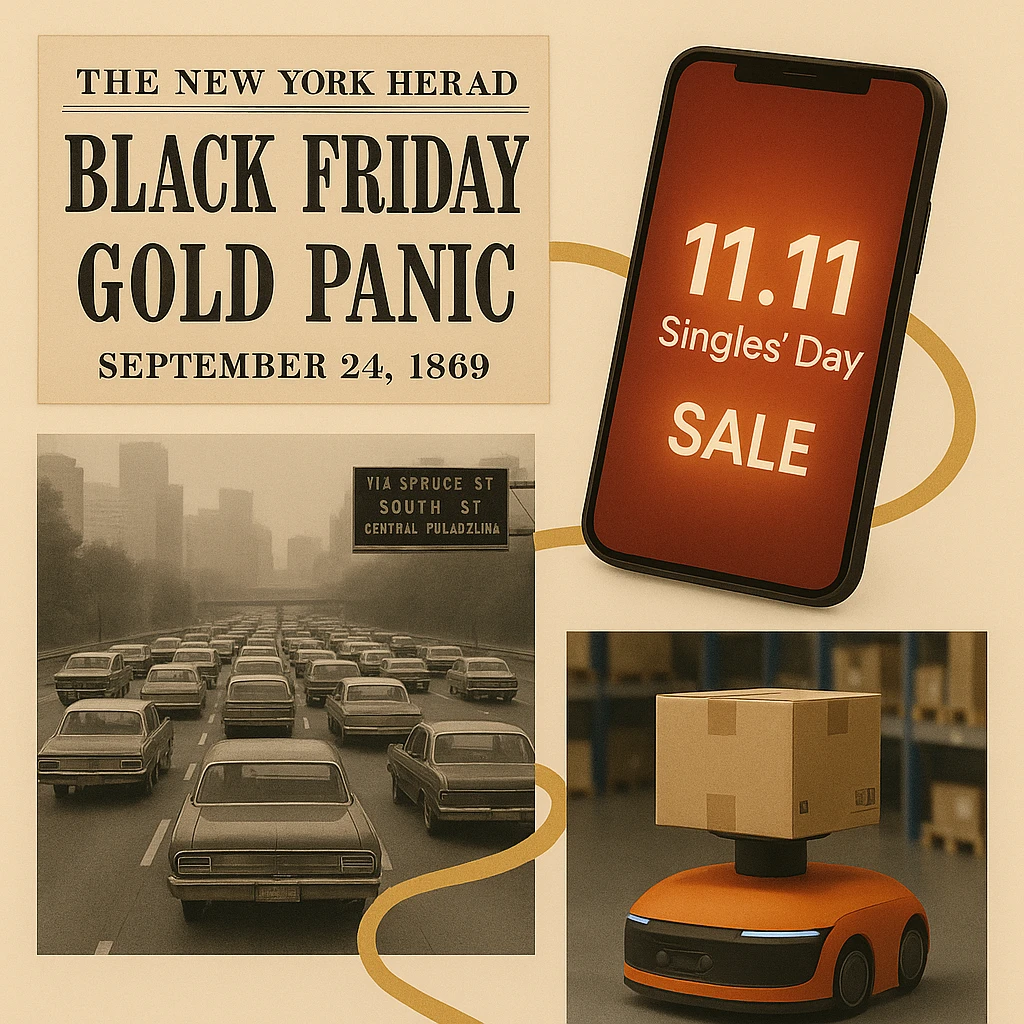
The first time “Black Friday” was used in an economic sense was on September 24, 1869. That day, a financial crisis broke out when two Wall Street investors, Jay Gould and Jim Fisk, tried to take over the country’s gold market. Their plan sent gold prices through the roof before it fell apart, causing a stock market crash that left everyone, from Wall Street barons to farmers, broke. The press called the day “Black Friday,” which was a common term at the time for bad financial events. This historical note is important because it shows that the phrase has been around for a long time and was originally negative, not about making money.
Philadelphia Police & the Retail Meaning (1950s–1960s)
The modern shopping holiday has its roots in Philadelphia in the middle of the 20th century. “Black Friday” was the name city police gave to the crazy day after Thanksgiving. For the annual Army-Navy football game on Saturday, thousands of people from the suburbs and tourists would come to the city. This would cause huge crowds, traffic jams, and a rise in shoplifting. Officers had to work long, grueling shifts and were denied leave, making it a day they dreaded. For years, people inside used the term before it was published.
The Mall Era (1980s–1990s) and the Beginning of Doorbusters
In the 1980s and 1990s, when suburban mall culture grew, stores all over the country made Black Friday the start of the holiday shopping season. During this time, the “doorbuster” deal came about. It was a very cheap item with a limited number of units that was meant to draw in huge crowds. Stores like Walmart, Toys “R” Us, and mall anchor stores like Sears and JCPenney fought hard over the prices of TVs, video game consoles, and toys. These loss leaders weren’t really about making money; they were more about getting people to come in, with the idea that once they were there, they would buy full-margin items. Aggressive TV and print advertising made the ritual of scanning newspaper circulars, camping out in parking lots, and rushing through doors at dawn a part of American culture.
From Mall Madness to Online Dominance (2000s–2010s)
E-commerce came along in the new millennium and changed Black Friday forever.
Early 2000s: Amazon Era
While Amazon was founded in 1994, its impact on Black Friday became pronounced in the early 2000s. The company started its own post-Thanksgiving sales, which were a great alternative to going to stores. It became less necessary to brave the crowds because it was easier to shop from home and members got free shipping. This period marked the beginning of a slow but steady power shift.
The Change to Shopping Online
A pivotal moment came in 2005, when the National Retail Federation coined the term “Cyber Monday” to describe the surge in online sales on the Monday after Thanksgiving weekend. Initially framed as a separate event for people shopping from work computers, it inadvertently accelerated the digitalization of the entire weekend. Major retailers began replicating their Black Friday deals online, often starting on Thanksgiving Day itself. This blurred the lines between the physical and digital events and gave rise to “Black Friday creep,” where deals started earlier and earlier in November.
The Digital Advertising and Mobile Revolution
The smartphone, especially after the iPhone came out in 2007, changed the game. By the early 2010s, mobile shopping apps and optimized websites became the primary research and purchasing tools for millions. Consumers could now compare prices in real-time while standing in a physical store line, increasing price transparency and competition. Digital advertising went from sending out a lot of emails to using advanced social media retargeting and search engine marketing. This made newspaper circulars useless because they could send personalized deal alerts.
Black Friday Around the World
The American retail holiday began exporting itself in the 2000s, with varying degrees of success and adaptation.
Expansion to Europe, UK, Canada, Australia
Black Friday became popular around the world thanks to multinational stores like Amazon, Apple, and Walmart-owned ASDA in the UK. In the United Kingdom, it grew from a niche event to a major sales period. Canada accepted it as a way to stop people from shopping across the border. But the adoption didn’t always go smoothly. In some parts of Europe, the event faced cultural resistance and criticism for encouraging people to buy too much. Sales numbers didn’t always match those of the US event.
Competing with Boxing Day and Singles’ Day
Black Friday had some tough competition around the world. Alibaba’s Singles’ Day (November 11) in China is much bigger than Black Friday. Since it became a business in 2009, it has set record-breaking sales totals every year. Its model, centered on entertainment-driven live streams and gamified discounts, has influenced global e-commerce strategy. This makes for a split promotional calendar.
Black Friday 2020–2024: the Pandemic Speeding Up and the Digital Revolution
The COVID-19 pandemic sped up the evolution of retail by ten years in just two years.
COVID-19 Impact
The 2020 Black Friday season was a turning point. Retailers had to move their businesses entirely online because physical stores were closed or had to limit the number of customers they could serve. Curbside pickup, which used to be a nice thing to have, became a need. Amazon and other online-only stores grew faster than ever before, while mall-based stores rushed to set up working omnichannel services.
Supply Chain Turbulence
The lockdowns caused by the pandemic and the surge in demand that followed them caused supply chain problems that had never happened before. In 2021 and 2022, there were a lot of inventory shortages because ports were crowded, there weren’t enough containers, and manufacturing was slow. This made stores start their “Black November” sales earlier than ever to even out demand and handle logistics. This trend has continued.
Debates about BNPL, inflation, and prices
During this time, “Buy Now, Pay Later” (BNPL) services like Affirm, Klarna, and Afterpay became popular. These services, which were built into the checkout process, helped people keep track of their budgets during times of high inflation, which helped them pay for their Black Friday purchases. At the same time, shoppers became more skeptical and used price-tracking tools to check retailers’ claims of “deep discounts” and put to rest rumors about price increases on some items before Black Friday.
What Happened This Year on Black Friday 2025?
The 2025 event has made the trends of the last ten years even stronger, marking the end of the digital transformation.
Online Sales Are Higher Than Store Sales
For the first time, even though people could go back to stores as usual after the pandemic, online sales over the whole Black Friday weekend were much higher than in-store sales. Most people now prefer to shop online because it is easier, has more options, and allows for personalized deals.
Fewer People at Malls
The physical doorbuster crowd is not as big as it used to be. Most doorbusters are now available in the same amount online, and stores have switched to “click-and-collect” models.
Pricing and personalization based on AI
AI is now in charge of Black Friday prices and marketing. Dynamic pricing algorithms change discounts in real time based on things like how much stock is available, how much competitors are charging, and how much each user wants. People no longer get a universal flyer. Instead, they get personalized deal recommendations through app notifications and social media feeds based on their own browsing and purchase history.
“Black November”: Longer Sale Calendar
The one-day event has turned into a month-long promotion. Major stores now offer “waves” of deals throughout November. This takes some of the pressure off of a single weekend and makes it easier to manage inventory and logistics. The term “Black Friday” is now a high point in a long sales season.
Payments and BNPL on Mobile Devices First in 2025
It is common to have mobile wallets and one-click checkout. BNPL has become even more popular, with options available at almost every online and physical checkout. This shows a major change in how people pay for things they want.
Sustainability and Anti-Haul Trends
More and more people are speaking out against Black Friday’s consumerism. The “anti-haul” movement on social media, where people who have a lot of followers tell others not to buy things on a whim, and the promotion of “Buy Nothing Day” have become more popular. In response, a lot of brands now focus on things like sustainability, product durability, and circular economy models like recycling programs to keep up with these changing values.
The Effects of Black Friday 2025 on the Economy
The 2025 event gives us clear information about how retail has changed.
Sales Totals Compared to Past Years
Even though overall sales totals are growing slowly from year to year, this number is heavily affected by inflation and the longer sales period. When you take inflation into account and spread the spending over November, the amount spent per day has stayed the same.
Metrics for Consumer Behavior
Key metrics now focus on the online experience. Average Order Value (AOV) for online carts, cart abandonment rates, and mobile conversion rates are the new KPIs, taking the place of foot traffic counts. Data shows a consumer who is more deliberate, better researched, and less impulsive than in the peak mall era.
How Much the Price Changes and How Deep the Discount Is?
The real discounts are different for each category. Electronics and appliances still get the biggest price cuts, but clothes and home goods often get smaller ones. Customers can see more price history data, which makes them more picky and less likely to be swayed by generic “sale” labels.
Conditions For Workers in Retail, Safety, and Labor
The risks and demands on retail workers have changed over time.
Overtime, strikes by workers, and union actions
The focus of labor action has changed from protesting early Thanksgiving hours to making bigger demands for higher pay, better benefits, and regular scheduling. A lot of people are trying to unionize at big stores like Starbucks and Amazon. This has brought up the issue of working conditions during the busy holiday season.
Stampedes and Modern Crowd Control
The 2008 Walmart stampede that killed an employee in New York and other tragic events led to major changes in safety. Virtual queues and lottery systems now handle physical doorbusters for items that are in high demand, making stampedes a thing of the past.
The Change from Physical Chaos to Digital Lines
The physical strain on workers has been partly replaced by the digital strain of fulfilling orders from all channels. The pressure has shifted to warehouse workers who pick up online orders and store associates who handle an endless stream of curbside pickups and returns.
Scams, fraud, and consumer risk in 2025
Digital threats are now the biggest risks for shoppers.
Fake Deals, Phishing Emails, and Scams on the Web
Cybercriminals take advantage of the shopping frenzy by sending out fake phishing emails that look like they’re from well-known stores, setting up fake retail websites with deals that are too good to be true, and running fake ads on social media. During the holidays, the FBI and FTC often warn people about these kinds of scams.
Chargebacks and Protecting Consumers
Because more people are using BNPL and shopping online, fraud disputes and chargebacks are becoming more complicated. Credit cards offer better fraud protection than debit cards, so people should use them. They should also be careful about buying things on websites that aren’t secure.
Advice on Safe Shopping
Standard advice for 2025 includes checking website URLs, using a password manager, turning on two-factor authentication, keeping a close eye on bank statements, and knowing the exact terms and conditions of BNPL agreements.
What We Can Learn About the Future From Black Friday 2025?
The event in 2025 is not the end, but it is a clear sign of where things are going in the future.
The End of Old-Fashioned Doorbusters
The idea of a physical item that is only available in small quantities to draw a crowd is pretty much dead. The “lightning deal,” or limited-time online flash sale, is the next step. It makes people feel like they need to act quickly without putting themselves in danger.
What Will Happen in 2026 and Beyond?
We can expect social commerce to grow even more, with purchases made through platforms like TikTok Shop and Instagram, AI-powered personal shoppers that make gift lists, and augmented reality (AR) features that let you try things out before you buy them.
The Growth of AI, Social Commerce, and Changing Prices
Black Friday will still be a data-driven event at its core. AI will make everything better, from predicting what will happen in the supply chain to making ads that are very specific to each person. Dynamic pricing will change so much that two shoppers may not see the same price for the same item, depending on how much they think they are willing to pay. The event will change from a group ritual to a shopping experience that is more personal and managed by algorithms.
Conclusion
In the end, the history of Black Friday is one of constant change. It has always reflected the larger economic and technological trends of its time, from a financial crash and a police officer’s complaint to mall madness and now to a mobile-dominated, AI-powered global phenomenon. In 2025, it is still a strong economic force, but it has changed into something that is more spread out, more personal, and more a part of the digital fabric of our daily lives. Not in parking lots at dawn, but in the complicated interactions between data, algorithms, and changing consumer values will shape its future.